
Automating the End-to-End Campaign Workflow
Eliminating the Campaign Code Bottleneck: How a Global SaaS Leader Automated Its Entire Campaign Creation Workflow Across Wrike, Marketo, and Salesforce

For a global SaaS technology company running hundreds of marketing campaigns a year, campaign operations should have been a competitive advantage. Instead, it was a bottleneck.
Every campaign — whether a webinar, a paid media push, a field event, or a content launch — required a campaign code before anything could move. That code had to be manually created, tracked in a spreadsheet, and then individually entered into Marketo and Salesforce by the ops team. Marketers couldn’t act independently. Every campaign request meant a ticket to ops, a wait, a copy-paste chain across three systems, and an opportunity for something to go wrong.
At scale, this wasn’t just inefficient. It was a structural constraint on how fast the marketing team could operate.
They came to TheCloudPartner not to patch the process — but to eliminate it entirely.
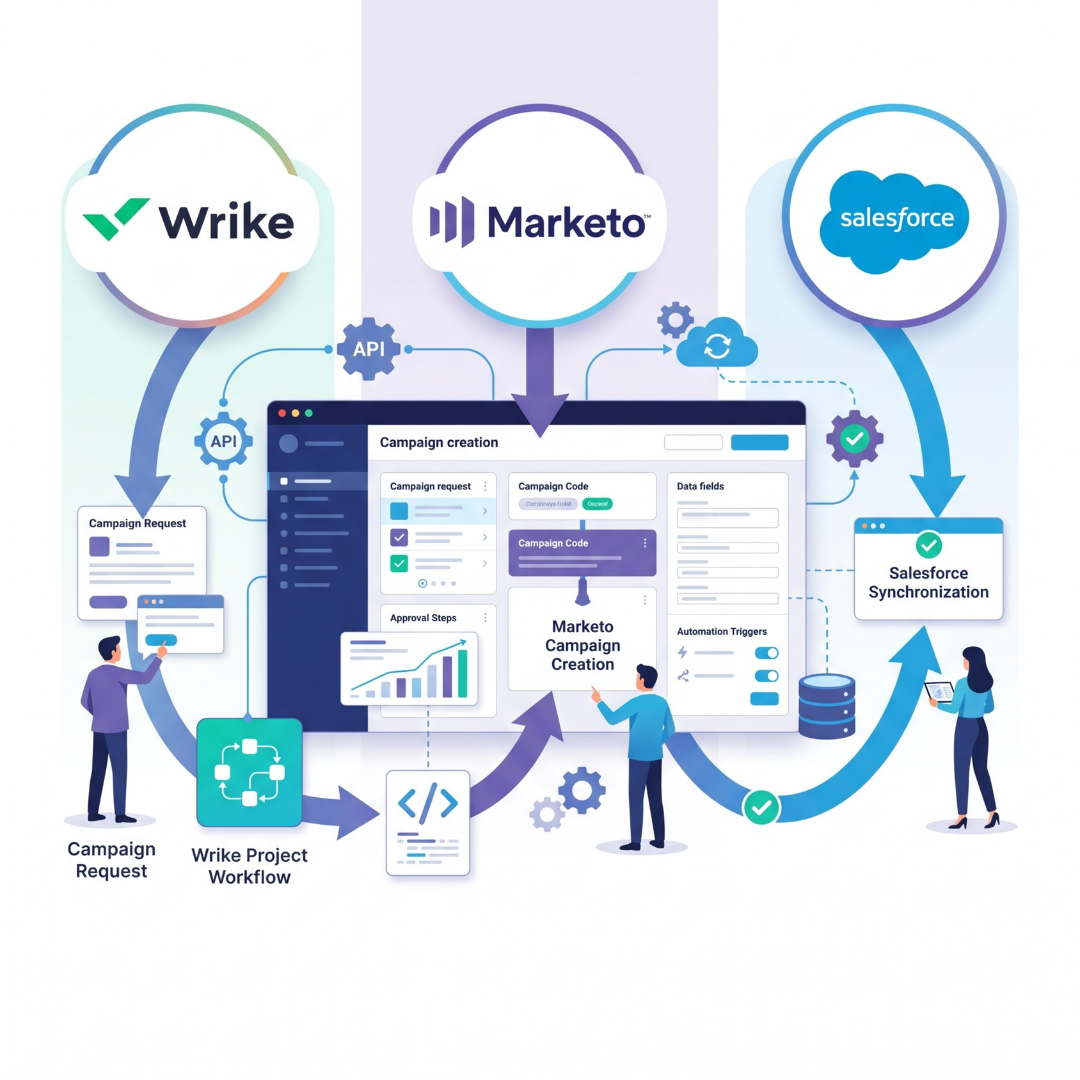
Eliminating the Campaign Code Bottleneck: How a Global SaaS Leader Automated Its Entire Campaign Creation Workflow Across Wrike, Marketo, and Salesforce
For a global SaaS technology company running hundreds of marketing campaigns a year, campaign operations should have been a competitive advantage. Instead, it was a bottleneck.
Every campaign — whether a webinar, a paid media push, a field event, or a content launch — required a campaign code before anything could move. That code had to be manually created, tracked in a spreadsheet, and then individually entered into Marketo and Salesforce by the ops team. Marketers couldn’t act independently. Every campaign request meant a ticket to ops, a wait, a copy-paste chain across three systems, and an opportunity for something to go wrong.
At scale, this wasn’t just inefficient. It was a structural constraint on how fast the marketing team could operate.
They came to TheCloudPartner not to patch the process — but to eliminate it entirely.
Challenges
The team was dealing with a set of deeply embedded operational problems that had compounded over time as the marketing program grew.
Campaign Codes Lived in Spreadsheets
There was no system of record for campaign codes. Marketers maintained manually updated spreadsheets to track naming conventions, assign codes, and ensure no duplicates crept in. As the team and campaign volume grew, this became increasingly error-prone — and entirely dependent on individuals knowing the rules and following them consistently.
Every Campaign Required an Ops Ticket
Marketers could not create campaign codes themselves. Each request had to be routed to the marketing ops or IT team, who would generate the code, manually enter it into Marketo to create the program, and then replicate the same information into Salesforce to create the corresponding campaign. This created a queue that slowed every campaign launch — sometimes by days.
Wrike, Marketo, and Salesforce Were Completely Disconnected
Wrike was the team’s project management and campaign intake tool. But it had zero connection to Marketo or Salesforce. A campaign could be fully briefed, approved, and in-flight in Wrike with no corresponding program or campaign record existing in either marketing or CRM system. The three platforms operated as independent silos, and keeping them aligned required constant manual synchronization.
Inconsistent Naming and Attribution Gaps
Because campaign codes were created manually by different people at different times, naming conventions drifted. Codes in Marketo didn’t always match codes in Salesforce. Attribution reporting was undermined by the inconsistency — making it difficult to tie campaign spend to pipeline with any confidence.
Approach and Implementation
TheCloudPartner took an automation-first, logic-first approach — designing the business rules before building a single integration.
Campaign Intake Redesign in Wrike
The team started by redesigning the Wrike campaign intake form to capture all the inputs needed to generate a campaign code: campaign type, region, business unit, fiscal quarter, channel, and other relevant attributes. This form became the single point of entry for every campaign — replacing email requests, Slack messages, and spreadsheet rows.
Business Logic Engine in Workato
The core of the solution was a Workato automation that listened for new Wrike intake form submissions and applied a complex set of business rules to generate a structured, standardized campaign code. The logic accounted for campaign type hierarchies, regional naming conventions, fiscal period formatting, and uniqueness validation — replicating and enforcing rules that had previously existed only in people's heads or in spreadsheet documentation.
Automated Marketo Program Creation
Once the campaign code was generated, Workato used the Marketo API to automatically create the corresponding program — pre-configured with the correct program type, channel, tags, and period cost fields populated from the Wrike intake data. Marketers no longer needed to touch Marketo to stand up a new program. It was already there when they needed it.
Automated Salesforce Campaign Creation
Simultaneously, Workato created the matching Salesforce campaign record — with the same campaign code, synchronized naming, and relevant metadata mapped from the Wrike form. The Marketo program and Salesforce campaign were linked from the moment of creation, ensuring attribution was clean from day one.
Writeback to Wrike
The generated campaign code was written back into the originating Wrike task, giving the marketer immediate confirmation and a permanent record of the code tied directly to the project. No spreadsheet lookup required.
Validation and Error Handling
Every step of the Workato recipe included validation logic: duplicate code checks, required field verification, and API error handling with Slack alerts to the ops team if any step failed. The system was built to be self-correcting and transparent — not a black box.
Results
The impact was immediate and measurable from the first week of go-live.
180 Hours Saved Per Month
The end-to-end automation eliminated the manual work of campaign code creation, spreadsheet management, and cross-system data entry across the entire marketing ops team. What previously consumed a significant portion of ops bandwidth every month was reduced to zero.
Marketer Self-Sufficiency
For the first time, marketers could launch a campaign without waiting on ops. Filling out the Wrike intake form was all it took — the code, the Marketo program, and the Salesforce campaign were created automatically within minutes. Campaign launch timelines shortened significantly.
Consistent, Governed Campaign Codes Across All Systems
With business logic enforced in Workato rather than in human memory, every campaign code generated was structurally consistent and correctly formatted. Naming drift was eliminated. Marketo and Salesforce always matched. Attribution reporting became reliable in a way it simply hadn’t been before.
Ops Team Refocused on Strategic Work
With routine campaign creation fully automated, the marketing ops team reclaimed bandwidth that had been consumed by repetitive data entry. That capacity was redirected toward campaign performance analysis, tooling improvements, and higher-value program support.
A Scalable Campaign Operations Foundation
Campaign volume can now grow without a corresponding increase in ops workload. New campaign types, regions, or business units can be added to the intake logic with configuration changes — not re-engineering. The system is built to scale with the business.
Testimonial
Key Takeaways
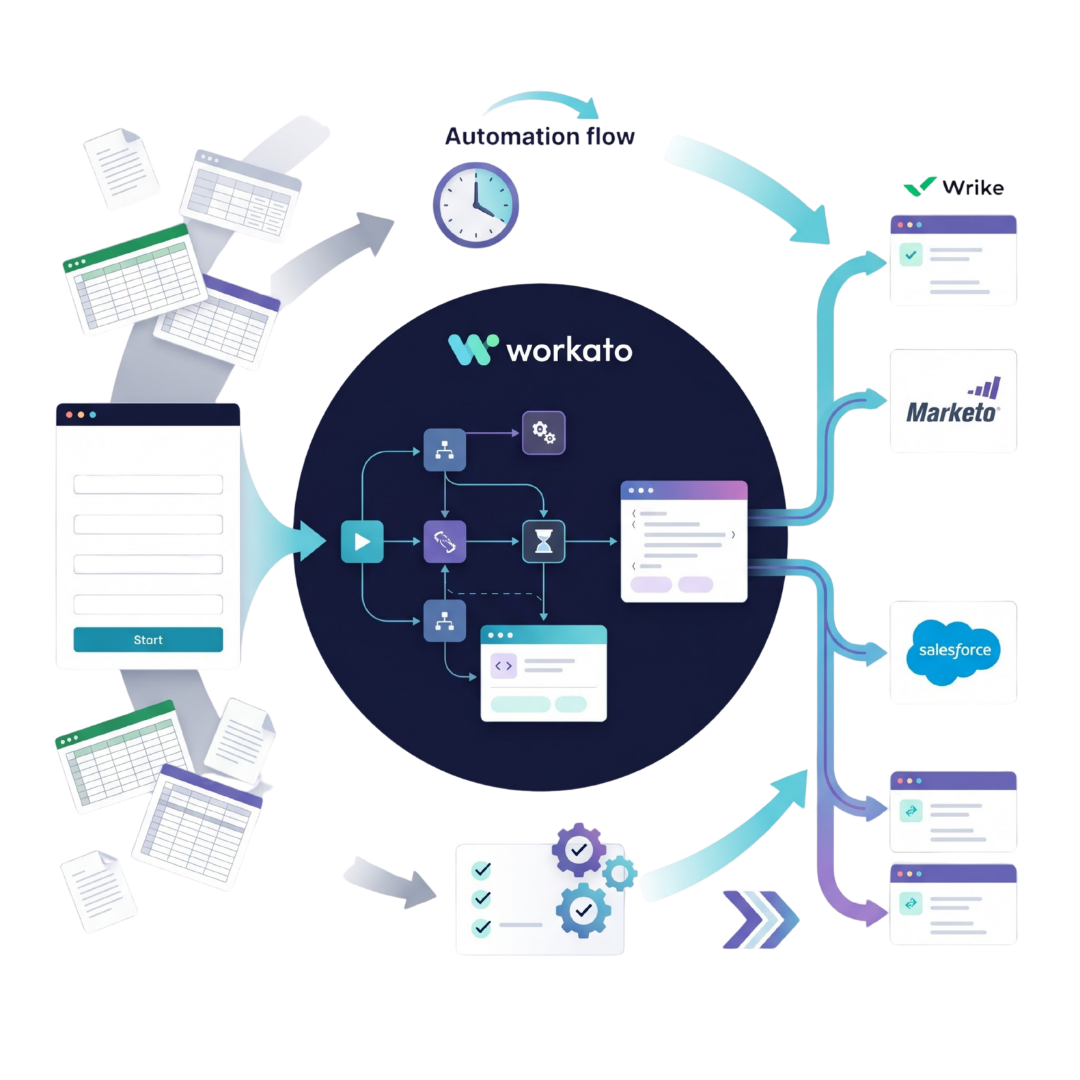
This engagement is a textbook example of what TheCloudPartner calls operational debt in disguise: a manual process that feels manageable at small scale, but quietly becomes one of the biggest constraints on marketing velocity as the business grows.
The campaign code bottleneck wasn’t a technology problem — it was an architecture problem. The tools (Wrike, Marketo, Salesforce) were all capable. What was missing was the intelligent automation layer connecting them, governed by the business logic that previously lived only in spreadsheets and institutional knowledge.
By re-centering the workflow on the Wrike intake form and building a Workato automation that enforced consistent business rules end-to-end, TheCloudPartner delivered something more than time savings: they gave a global SaaS marketing team the ability to operate at the speed their business actually demands.
180 hours saved per month. Zero manual campaign codes. One intake form. That’s what modern MarTech operations looks like.
Ready to eliminate your marketing ops bottlenecks?
Let’s design an integration architecture that lets your team move faster — without adding headcount.