
Scaling Enterprise ABM with Adobe Marketo Engage
From Leads to Buying Groups: Scaling Enterprise ABM with Adobe Marketo Engage

Turn Account-Based Marketing Strategy into Scalable Execution
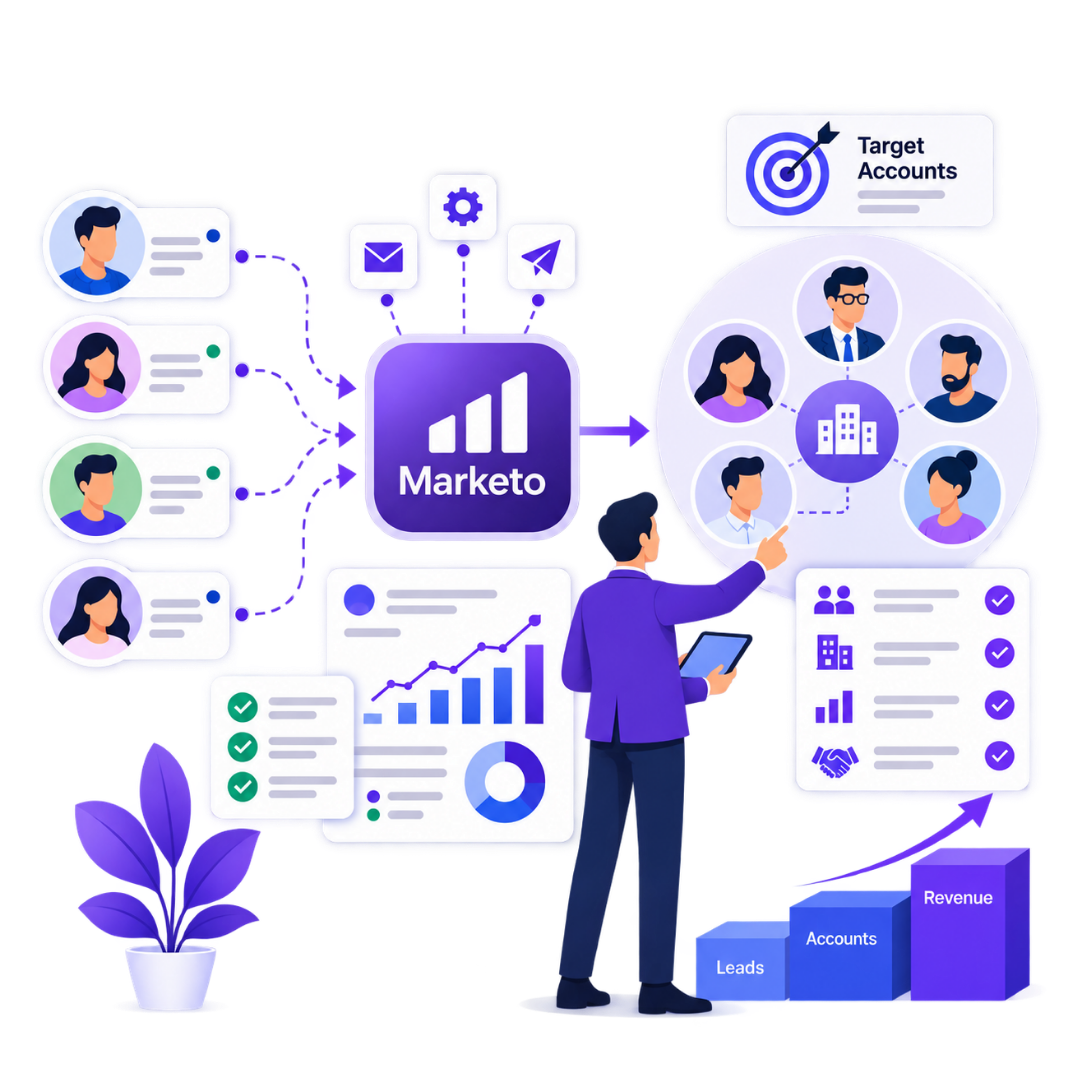
Enterprise B2B buying involves multiple stakeholders across departments, roles, and stages.
The challenge is identifying the right accounts, engaging buying groups, aligning sales and marketing, and measuring account-level impact at scale.
Adobe Marketo Engage provides the automation and orchestration foundation for enterprise ABM.
TheCloudPartner helps connect Marketo with CRM, data, integration, and AI to build a scalable ABM operating model.
From Leads to Buying Groups: Scaling Enterprise ABM with Adobe Marketo Engage
Turn Account-Based Marketing Strategy into Scalable Execution
Enterprise B2B buying involves multiple stakeholders across departments, roles, and stages.
The challenge is identifying the right accounts, engaging buying groups, aligning sales and marketing, and measuring account-level impact at scale.
Adobe Marketo Engage provides the automation and orchestration foundation for enterprise ABM.
TheCloudPartner helps connect Marketo with CRM, data, integration, and AI to build a scalable ABM operating model.
Why Enterprise ABM Is More Than Targeting Accounts
Traditional demand generation focuses on individual leads—from content engagement and scoring to sales qualification.
ABM shifts the focus from leads to target accounts and buying groups.

ABM asks: “Is this account showing meaningful buying activity?”
Key signals include:
- Who is engaging?
- Which roles and topics are involved?
- How many stakeholders are active?
- Which campaigns are influencing them?
- What is the sales and opportunity status?
- Where is the buying group in its journey?
Marketo helps combine these signals and turn them into coordinated marketing actions.
Building the Foundation for Enterprise ABM
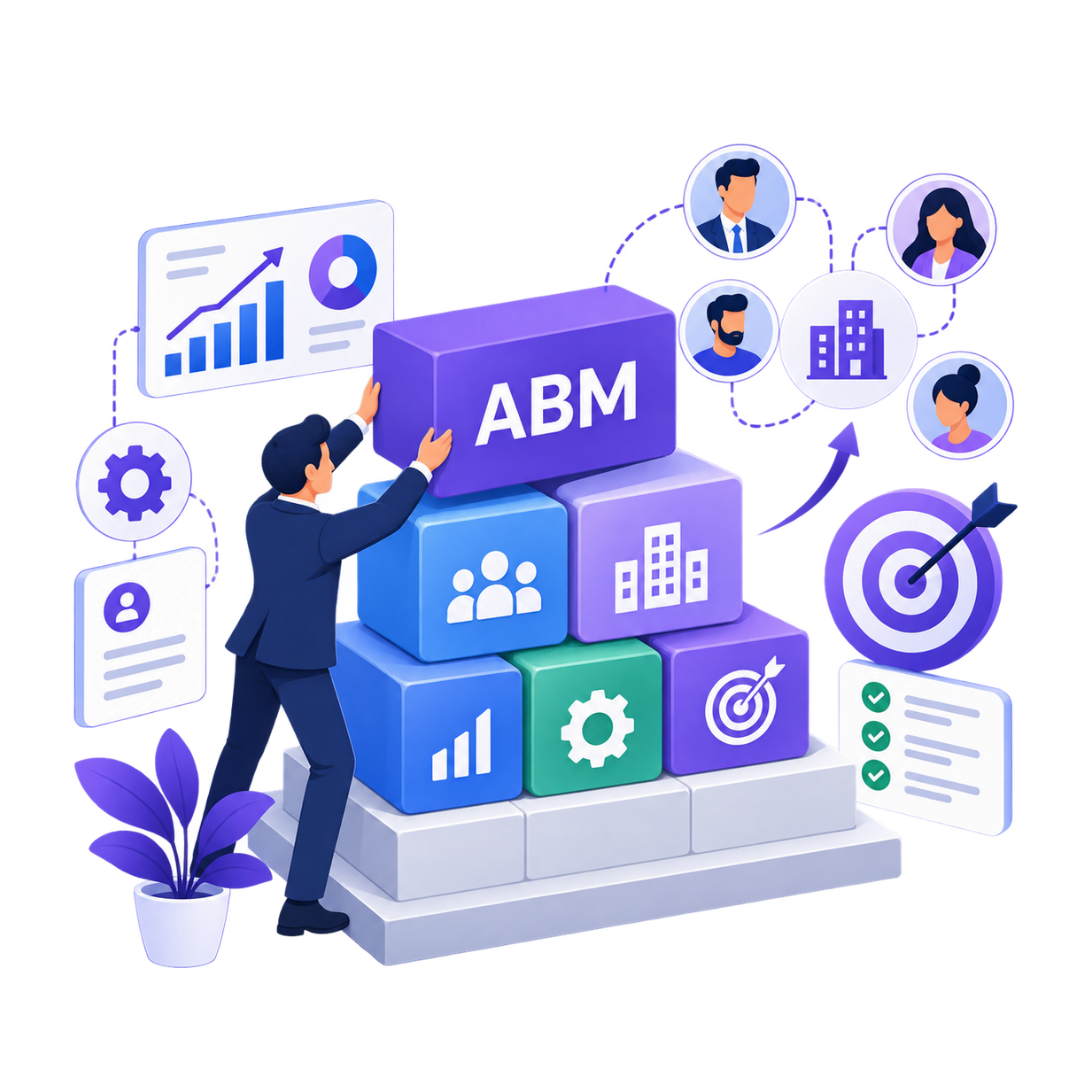
Successful ABM starts with reliable account and contact data—the foundation for personalization and targeted campaigns.
Connect People to Accounts
Scalable ABM requires accurate account matching and reliable data.
Marketo can work with CRM and data platforms to connect people with accounts and maintain key attributes such as:
- Industry
- Company Size
- Geography
- Revenue
- Account Tier
- Customer Status
- Product Interest
- Sales Ownership
- Opportunity Status
This foundation enables account-level engagement instead of isolated lead activity.
Identify and Prioritize the Right Accounts
Not every account should receive the same level of marketing investment.
Enterprise ABM programs typically prioritize accounts using a combination of fit and engagement.

Account Fit
Does the organization match your ideal customer profile?
Signals may include:
- Industry
- Revenue
- Employee count
- Geography
- Technology environment
- Customer profile
- Strategic account status
Account Engagement
Is the account demonstrating interest?
Signals may include:
- Website activity
- Content downloads
- Email engagement
- Webinar participation
- Event attendance
- Product-page visits
- Campaign responses
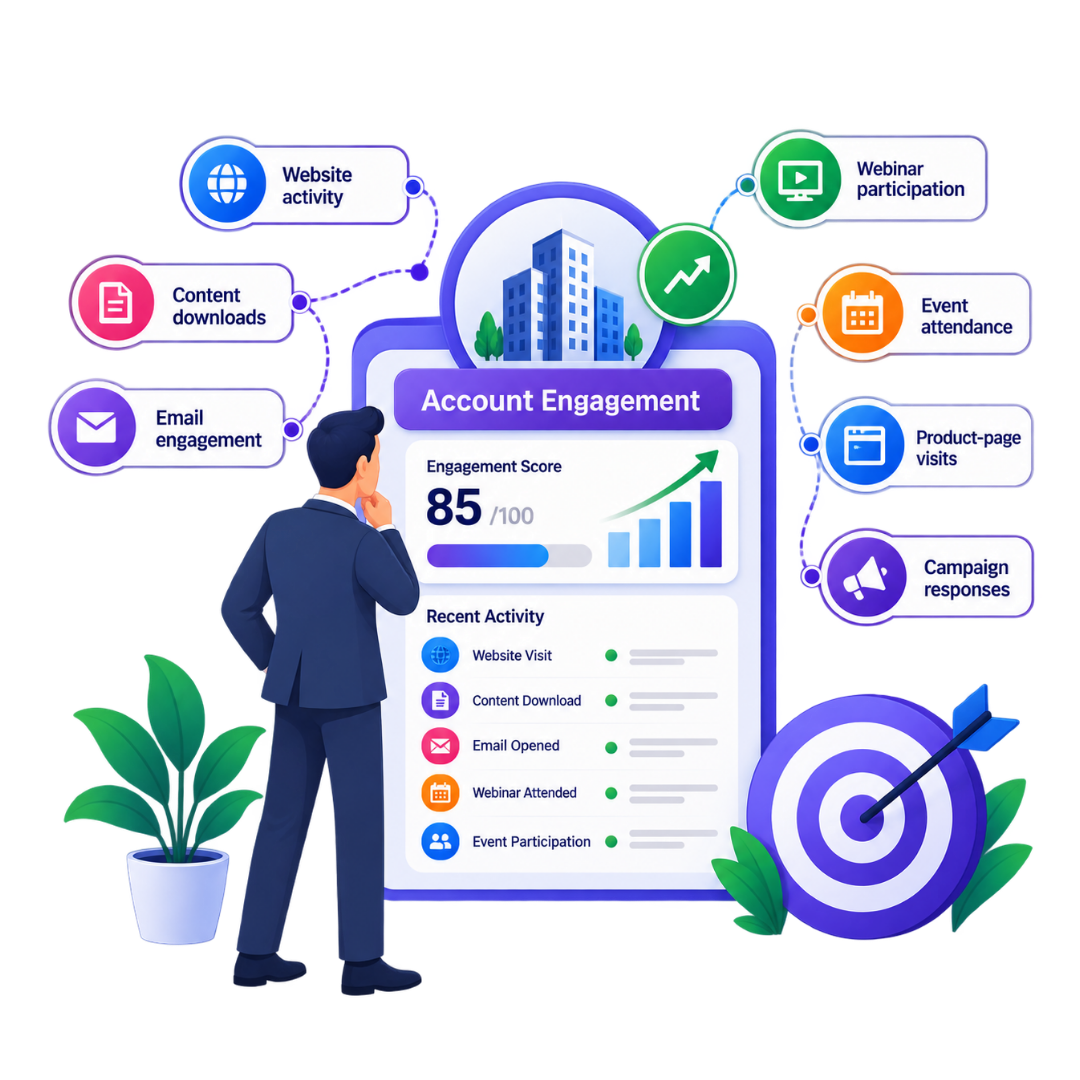
Combining these dimensions allows marketing teams to differentiate between an account that simply fits the ICP and one that is actively demonstrating buying behavior.
That distinction is essential for effective ABM prioritization
Move from Lead Scoring to Account Engagement
Traditional lead scoring is useful, but enterprise buying involves multiple stakeholders.

- Enterprise buying involves multiple stakeholders from the same account.
- Different stakeholders may engage through reports, webinars, product pages, or events.
- Individual engagement can hide a key signal: the account may be entering an active buying cycle.
- ABM aggregates engagement across contacts to identify account-level intent.
- This enables earlier and more coordinated Marketing and Sales action.
Engage the Entire Buying Group
- Enterprise purchases involve multiple stakeholders.
- Buying groups may include:
- Decision Makers
- Technical Evaluators
- Business Users
- Champions
- Procurement
- Executive Sponsors
- Each stakeholder has different priorities and questions.
- Marketo enables segmentation based on role, persona, behavior, industry, account tier, and lifecycle stage.
- This helps deliver relevant experiences across the entire buying group.

Personalize Experiences at Scale
Personalization is a major ABM opportunity, but creating separate campaigns for hundreds of accounts isn’t sustainable. A better approach is to use reusable campaign frameworks that adapt to account and audience data.
Marketo can support personalization across:
- Landing pages
- Nurture programs
- Event communications
- Content offers
- Calls to action
- Follow-up journeys
Personalization can happen at multiple levels:
Industry-Level
Tailor messaging to specific industries.
Persona-Level
Adapt content for executives, practitioners, and technical buyers.
Account-Tier Level
Differentiate experiences for strategic and target accounts.
Behavioral Level
Personalize journeys based on engagement.
This makes ABM personalization scalable without manual campaign creation.
Orchestrate Multi-Channel Account Journeys
Enterprise buyers interact with brands across many channels.
A target account may engage through:
- Website
- Webinar
- Event
- Paid Media
- Sales Conversation
Marketo can orchestrate engagement and move audiences through coordinated journeys. For example:
- Target Account Identified
- Buying Group Members Engaged
- Relevant Content Delivered
- Account Engagement Increases
- High-Intent Threshold Reached
- Accurate segmentation
- Sales Alerted
- Sales and Marketing Coordinate Follow-Up
This turns ABM from a collection of campaigns into an orchestrated account journey.
Connect Marketing and Sales Around the Same Account
ABM cannot succeed as a marketing-only initiative.
Sales and Marketing need a shared understanding of:
- Target accounts
- Account ownership
- Buying-group members
- Engagement
- Campaign activity
- Intent
- Opportunities
- Recommended action
Connecting Marketo with CRM platforms such as Salesforce enables marketing engagement data to become part of the sales workflow.
-
Sales teams can understand which contacts are engaging, what content interests them, which campaigns influenced the account, and when engagement is increasing.
-
Marketing can simultaneously use CRM information to adjust campaigns based on account ownership, opportunity stage, customer status, or sales activity. The result is a connected feedback loop between Marketing and Sales.
Use Automation to Trigger the Next Best Action
ABM becomes significantly more powerful when account signals trigger actions automatically.
Consider an account where:
- Multiple stakeholders engage with content
- A decision-maker attends an event
- Product-page activity increases
- The account matches the ideal customer profile
Instead of waiting for someone to manually identify the pattern, automation can respond.
Possible actions could include:
- Increase account priority
- Move contacts into a higher-intent journey
- Notify the account owner
- Recommend sales follow-up
- Add the audience to an appropriate campaign
- Trigger additional personalized content
The objective is to reduce the gap between buyer intent and business action.
Add AI to the ABM Operating Model
ABM generates large amounts of data. AI can help organizations interpret those signals more efficiently.
When connected with Marketo and the broader MarTech ecosystem, AI can support areas such as:
Persona & Buying-Role Classification
Classify job titles and profile information into standardized personas and buying-group roles.
Account Prioritization
Analyze multiple fit and engagement signals to identify accounts that deserve attention.
Content Recommendations
Recommend content based on persona, industry, account stage, and previous engagement.
Engagement Analysis
Identify patterns across contacts that may indicate growing account intent.
Campaign Optimization
Analyze campaign performance and recommend improvements.
Marketing Operations
Assist teams with campaign QA, data management, reporting, and workflow analysis.
AI does not replace Marketo’s deterministic automation.
It adds an intelligence layer that can help Marketing and Sales make better decisions from the data Marketo and connected platforms already generate.
Build a Connected ABM Technology Architecture
Engagement & Automation
Adobe Marketo Engage — Orchestration, nurturing, personalization, scoring, and segmentation.
Customer & Revenue
CRM — Accounts, contacts, opportunities, and sales activity.
Data & Intelligence
Data + Enrichment + Intent + AI — Account insights, behavioral signals, and predictive data..
Integration & Orchestration
APIs + Integration Platforms — Connect systems, sync data, and automate workflows.
Channels
Web • Email • Events • Webinars • Advertising • Sales — Deliver coordinated experiences.
Goal: Build a connected account-engagement engine, not just an integrated tech stack.
Measure ABM Beyond Leads
ABM requires a broader measurement framework. Traditional metrics like opens, clicks, and MQLs are useful, but they don’t tell the full story. Enterprise teams should also measure:
Account Engagement
Are target accounts becoming more engaged?
Buying-Group Coverage
Are you reaching enough of the stakeholders involved in the decision?
Account Progression
Are accounts moving through meaningful stages of the buying journey?
Opportunity Creation
Are engaged accounts turning into pipeline?
Pipeline Influence
Which marketing activities are contributing to opportunities?
Revenue Impact
Are ABM programs driving closed business?
This shifts the focus from “How many leads did marketing generate?” to “How effectively are Marketing and Sales driving target accounts toward revenue?”
TheCloudPartner’s Approach to Marketo-Powered ABM
Technology alone doesn’t create successful ABM. The operating model matters just as much. TheCloudPartner approaches enterprise ABM across five connected areas.
Strategy
Define target-account strategy, segmentation, buying groups, lifecycle stages, and measurable business outcomes.
Data
Establish the account, contact, persona, engagement, and CRM data required to support ABM.
Architecture
Design how Marketo, CRM, data platforms, integrations, AI, and engagement channels work together.
Automation
Build scalable campaign frameworks, account journeys, scoring models, personalization, and operational workflows.
Optimization
Measure account engagement and pipeline impact while continuously improving campaigns and processes.
The result is an ABM ecosystem designed to scale beyond individual campaigns.
From Account-Based Marketing to Account-Based Growth
The future of ABM isn’t about sending more personalized emails to a list of target accounts.
It's about connecting:
- Account Data
- Buying Groups
- Engagement Signals
- Marketing Automation
- Sales Activity
- AI & Intelligence
When these elements work together, Marketo becomes more than a campaign automation platform.
It becomes part of an enterprise account-engagement engine connecting Marketing and Sales around the same customer journey.
Scale Your ABM Strategy with Adobe Marketo Engage
Whether you’re launching an ABM program, improving an existing Marketo environment, connecting Marketo with Salesforce, modernizing your lead and account lifecycle, or introducing AI into Marketing Operations, TheCloudPartner can help design and implement the technology foundation behind your strategy.
Build a connected ABM ecosystem that helps your teams identify the right accounts, engage the right buying groups, act on intent faster, and connect marketing activity to pipeline.

Ready to turn your ABM strategy into scalable execution?
Talk to TheCloudPartner about building your Marketo-powered Account-Based Marketing ecosystem.